Showing posts with label unasur. Show all posts

Wednesday, October 3, 2018

Diplomatic Courier: How Will the Demise of UNASUR Affect Latin American Integration?


"How Will the Demise of UNASUR Affect Latin American Integration?"
Wilder Alejandro Sanchez

Diplomatic Courier: A Global Affairs Media Network
3 October 2018
Originally published: https://www.diplomaticourier.com/2018/10/03/how-will-the-demise-of-unasur-affect-latin-american-integration/

The government of Colombia has announced that it will withdraw from the Union of South American Nations (Union de Naciones Sudamericanas – UNASUR), an initiative that brings together all 12 South American states. This bloc has been adrift for years due to the lack of a Secretary General, while its members are at odds with each other regarding the crisis in Venezuela. If this is the end of UNASUR, what will South America lose? Very little.

A Short Obituary
UNASUR was founded in May 2008, a time during which South America experienced a rise of leaders with left-leaning ideologies: Argentina’s Cristina Fernandez de Kirchner, Bolivia’s Evo Morales, Brazil’s Lula da Silva, Ecuador’s Rafael Correa, and Venezuela’s Hugo Chavez, among others. This common ideology prompted the creation of a new bloc in the Western Hemisphere to promote South American integration, though with no long-term goals and little structure other than the ideological views of its members. Even though some governments (namely Colombia) maintained close relations with the U.S. during UNASUR’s heyday in the early part of the decade, the group’s other objective was to distance the region from Washington’s historical influence over the Western Hemisphere.

It is worth noting that during this period other organizations appeared with similar objectives, such as the Community of Latin American and Caribbean States (CELAC) and the Venezuela-led Alianza Bolivariana para las Americas (ALBA).

To be fair, the Quito-based UNASUR did carry out some interesting initiatives in its early years. For example, it established a South American Defence Council, which attempted to promote defense cooperation in the region—some idealists argued that this agency could become the regional version of NATO. Additionally, the bloc supported President Evo Morales when Bolivia suffered major protests in 2008, and a coup d’etat was a real possibility.

Nevertheless, UNASUR was a creature of its time, and recent elections have brought more Washington-friendly leaders, like for example Mauricio Macri in Argentina. As a consequence, regional interest in UNASUR dramatically decreased. The most obvious example is that this organization has not had a Secretary General since January 2017, when former Colombian President Ernesto Samper finished his term—the current president pro-tempore is Bolivian President Evo Morales. Additionally, the political and socio-economic crisis in Venezuela has prompted a regional diplomatic crisis, with Venezuela and its ally Bolivia against the rest of South America.

It comes as no surprise that in late August, Colombia’s new president Ivan Duque announced that his country will leave UNASUR within six months; he argued that the bloc’s silence on the Venezuela issue is de facto supporting the Nicolas Maduro regime. Similarly, Chilean Foreign Affairs Minister Roberto Ampuero has reportedly discussed with other governments the possibility of leaving the organization. Other countries that are reportedly considering this possibility are Argentina, Brazil, Paraguay, and Peru; half of UNASUR’s membership.

An Alphabet Soup of Integration Efforts 
The Western Hemisphere has a plethora of diplomatic blocs such as the Organization of American States, CELAC, the Andean Community, the Caribbean Community, among others, as well as trade blocs like the Pacific Alliance and MERCOSUR. If UNASUR is dissolved, it will hardly be missed as there are other agencies that can replace it.
Certainly, the bloc had some interesting initiatives and objectives, however over the past decade it has done little to create a lasting legacy other than its support for President Morales in 2008. Should UNASUR dissolve, it will hardly affect regional integration, particularly because there is currently no long-term integration process in Latin America, other than increasingly close trade relations (i.e. the Pacific Alliance). The last war between two Latin American states was a short-lived war between Ecuador and Peru in 1995, hence a lack of diplomatic integration does not mean an increase in inter-state conflict (though there have been some occasional incidents as well as ongoing border disputes).
Even more, the lack of a European Union-style regional integration in South America should not be interpreted as a negative development, as the region should not use European integration as a standard to determine how successful, or unsuccessful, regional initiatives have been. Each region should integrate at its own pace and take into account its local geopolitics.

Final Thoughts
At the time of this writing UNASUR’s future is not optimistic, as Colombia plans to leave the bloc, and it is likely that other countries (i.e. Chile) will follow. It remains to be seen for how long can this bloc continue to operate without a secretary general, without all of its members, and with the Venezuelan crisis as a dividing issue. Theoretically, UNASUR could continue to exist, but it stopped behaving as a union a long time ago.

About the author: Wilder Alejandro Sanchez is an analyst who focuses on geopolitical, military and cyber security issues in the Western Hemisphere. The views expressed in this article are those of the author alone and do not necessarily reflect those of any institutions with which the author is associated.

Monday, April 23, 2018

Journal: On (the lack of) Latin American supranationalism


"On (the lack of) Latin American supranationalism"
W. Alejandro Sanchez
Global Change, Peace and Security
 Volume 29, 2017 - Issue 2
P. 179-187
Published Online 28 February 2017


This commentary discusses the state of supranationalism in Latin America. We will enumerate the numerous regional organizations in the Western Hemisphere, and also discuss their successes and failures at regional integration. While integration has had some successes, supranationalism has yet to flourish among Latin American states and it will probably not for the immediate future. Empirical evidence suggests that, while inter-state warfare is scarce in the region, there are still too many inter-state tensions, including ongoing border disputes, as well as occasional incidents, which prevent supranationalism from taking hold. This explains the lack of a North Atlantic Treaty Organization-esque type South American bloc. Nevertheless, small-scale integration projects have been successful, like visa waivers systems, educational programs or defense-cooperation projects. Ultimately, in a changing global geopolitical system, the distrust for supranationalism remains the same in Latin America.
KEYWORDS: Latin America, Caribbean, supranationalism, security, integration, geopolitics

*Please contact the author for free a PDF copy

Monday, January 12, 2015

COHA Report: LIFT OFF: DRONE USAGE IN LATIN AMERICA TAKES FLIGHT


"Lift Off: Drone Usage In Latin America Takes Flight"
W. Alejandro Sanchez
Council on Hemispheric Affairs - Report
January 12, 2015
Available: http://www.coha.org/lift-off-drone-usage-in-latin-america-takes-flight/

2014 could be remembered as the year when drone usage, both for military and civilian purposes, decisively took off throughout Latin America. The cherry on top of the proverbial cake was the recent decision by the South American Nations Union (UNASUR) to create a regionally-built drone. While this initiative may need a few years to materialize, it is nonetheless important as it stresses how increasingly widespread drone usage will become throughout the region in the near future.
South America Coming Together
Defense Ministry representatives from the twelve UNASUR members (all South American states) met in mid-December 2014 in Salvador, Brazil to discuss the manufacturing of an UNASUR drone. The gathering decided to support the regional construction of a drone, which should help internal security operations carried out by member states and will also serve as a confidence-building mechanism. Since a complete design concept has not been signed off yet, as the UNASUR drone is barely at the “discussion” phase, there are no specific details available. Nevertheless, it is worth mentioning that during the meeting in Brazil, South American officials decided that the drone must have sensors and electronic components that adapt to quick climate changes, it must be able to operate at long ranges, and the unmanned aerial vehicle (UAV) must have the ability to smoothly transfer guide controls from one installation to another.[i]
While UNASUR coordination is important, we should not assume that the design phase, much less the manufacturing, will begin anytime soon. History proves that although Latin American governments come together for ambitious initiatives, they tend to occur at a snail’s pace. The UNASUR drone is not the first time that the regional agency has come together to build an aircraft as a sort of challenge of its military technology capabilities and as a confidence building mechanism. In fact, UNASUR is already building a regional military training aircraft.
UNASUR’s ambitious project to construct an aircraft was originally announced around May 2013, but, according to recent reports, the prototype will only be finished by 2016.[ii] Argentina has taken the lead in this project as the aircraft’s design will follow that of the Argentine military aircraft IA-73, which is being constructed by the country’s Fábrica Argentina de Aviones. All UNASUR members are supposed to be involved in the project, either by helping to construct the aircraft or by serving as observers. Nevertheless, while the region is no stranger to manufacturing military aircrafts (the Tucano, constructed by Brazil’s EMBRAER comes to mind) the prototype of UNASUR-1, as the UNASUR plane will be called, will require at least one more year before it is finished.[iii] While smaller in size than an aircraft, a construction of a drone is much more technologically challenging, especially as domestic drone programs in South America are not as developed as other countries that manufacture these apparatus (i.e. the U.S. or Israel).
Finally, it is worth stating that other regions are similarly coming together to construct drones: seven European nations (France, Germany and Spain among them) have announced their intention to create a consortium to construct a “euro drone” by 2020.[iv]Certainly a number of European industries already manufacture drones, like the Swedish CybAero AB, but the goal is to construct a UAV to promote cooperation and confidence between several states, resulting in a state-of-the-art vehicle that other countries will want to purchase.[v]
As for the UNASUR drone, much needs to be clarified before an accurate timetable can be provided regarding construction schedules. It makes sense that Brazil may take a lead in this endeavor, as it already produces drones, but other countries, including Argentina, Colombia, Chile, Ecuador, and Peru, can provide technological expertise due totheir own production and usage of drones.[vi] However, while creating a UNASUR drone generally makes sense, the timetable of the UNASUR-1 plane serves as an example that one should not assume that even the most positive and sound initiatives will become a reality anytime soon.
Domestic Programs Grow
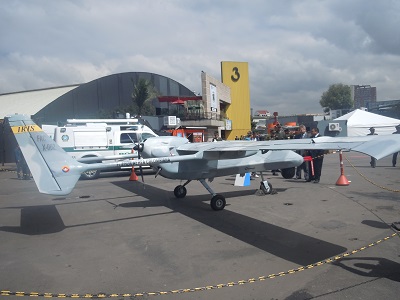
UNASUR’s project aside, Latin American countries continue to be interested in developing their own drones and have significantly expanded these programs in 2014. The most notable success came from Colombia, as the local weapons company, the Corporación Industrial Aeronáutica Colombiana (CINAC) unveiled the Iris, the South American nation’s first home-built drone this past year. The drone can reach a height of eight thousand feet, it can also travel as far as 100 kilometers and it features optic sensors and the Flir HD image system.[vii] For the time being, the Iris will be used by the Colombian armed forces for patrol missions, but the goal seems to be that it eventually will be exported. The Iris was showcased during the recently-ended UNVEX America 2014, a weapons fair that took place in Colombia, as a way for the country to demonstrate its emerging industrial military complex.
Foto: Carlos E. Hernández/INFODEFENSA.COM
Meanwhile, the Peruvian Air Force (FAP) will team up with the South Korean company Korea Aerospace Industries Ltd (KAI) to manufacture a new drone. KAI has sold a number of KT-1P military training aircraft to the FAP, hence there is already a history of joint cooperation between the two entities.[viii] As part of the agreement between KAI and the FAP over the transfer of the KT technology, the Korean company will provide technological expertise for the Peruvian Air Force’s Centro de Desarrollo de Proyectos (CEDEP, Center for Developing Projects) to manufacture a drone that can fly up to 24 hours and take thermal and night-time images. The goal would be to utilize this drone for surveillance operations in the Valley of the Apurimac, Ene and Mantaro Rivers (VRAEM) where the remnants of the narco-terrorist organization Shining Path operates.[ix] It should be remembered that the Peruvian Air Force already has developed several drone prototypes, but it appears that the UAV constructed in partnership with KAI will be actively used in real operations.[x]
Regarding Venezuela, not much is clear about its current drone program. Reports dating back to 2012 say that Iran and Russia were providing technological expertise so that the South American country can construct its own drones.[xi] The Venezuelan Air Force has at least two drone projects. One of them is Arpía, which is based on the Mohajer 2 drone (produced by Iran), while the other is called Gavilán.[xii] Unfortunately, reliable information about the current operational status of both drones is difficult to come by.
Ultimately, the possibility that Latin American drones will be exported to other countries and be competitive with American, Israeli or European UAVs is actually not a far-fetched scenario. Just this past August, it was reported that Brazil had exported its first drone, a FT-100 Horus, to an undisclosed African nation.[xiii] Israeli or American drones may be more advanced, but developing nations may choose to buy an efficient, but cheaper, “knock off” version, which could give Latin American drone exports an edge in the near future.
Drone Imports Will Continue in 2015
Latin American domestic drone programs may be cementing a position for themselves in the market, but they will take a couple of more years before they can be mass manufactured. Hence, Latin American nations will continue to import drones for the foreseeable future. Countries like Israel and the U.S. are obviously the major drone exporters to the region, but on occasion there have been disconcerting rumors about drone-deals with some unlikely suppliers.
Case in point, in late 2014 the Mexican media speculated that the Mexican government was planning to purchase drones from Iran.[xiv] The reasoning was that Mexico City wanted to improve ties with Tehran, and also needed more drones to combat drug trafficking. Nevertheless, the Mexican government categorically denied this report. It would have been a bizarre development if Mexico had indeed purchased drones from Iran, a country which has been at odds with the U.S., Mexico’s strategic ally, for decades. For the record Iran does produce drones, and it has helped Venezuela with its own drone program, but it is unlikely that Mexico would jeopardize its close security relations with Washington for a few UAVs.[xv]
As for less-controversial initiatives, the U.S. aerospace company Boeing has declared its intention to increase drone sales to Colombia. The Colombian Air Force is currently the sole operator in the region of Boeing’s Scaneagle and Nighteagle, which are utilized for internal security operations against drug-trafficking and counterinsurgency. Hence, it is logical to assume that the Colombian government would want to continue using drones that its personnel know how to operate. Moreover, this past October, Boeing’s Vice President for the Americas, Roberto Valla, explained that the company aims to sell more drones to the Colombian Navy, while Brazil and Chile, which operate Israeli drones, also seem to be interested in purchasing Boeing’s products.[xvi]
Apart from Boeing, another company aspiring to sell drones to Latin America is Aerovironment, which produces the Raven and Puma, which are already operated by the Colombian armed forces.[xvii]Countries like Chile, Mexico and Peru are apparently interested in purchasing them. Additionally, the Swedish firm Unmanned System Groups (USG), showcased its F-330 drone to the Uruguayan armed forces in late 2014.[xviii] However, a deal between USG and Montevideo has yet to be signed, though this could occur soon as the Uruguayan Army appears to be interested in acquiring them in order to support Uruguayan peacekeepers in Africa.[xix]Additionally, Israeli Aerospace Industries has declared that it may reach a deal in 2015 with the Mexican Air Force.[xx]
In other words, there are several contracts that could be signed within the coming months, which will mean that we will see Latin American militaries utilize an increasing number drones in the near future.
Civilian Drone
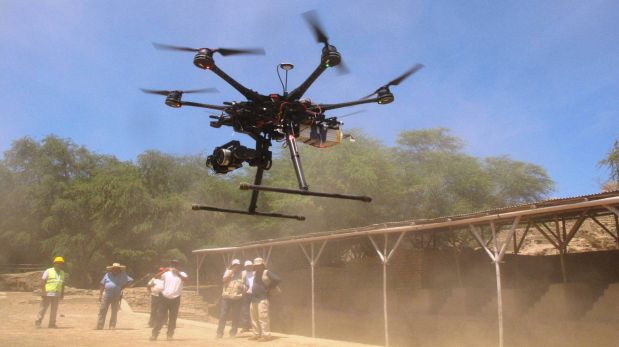
Finally, it is important to stress that drones are not only used for military purposes, they can also be used for a multitude of civilian activities. In this case, the usage of drones has become fairly widespread in the region. Case in point, drones have been used for archaeological purposes in the Amazonas region of northern Peru.[xxi] Archaeologists are interested in using drones as they can help create a 3D model of an archaeological dig by providing a “bird’s eye view.”[xxii]
Foto: Wilfredo Sandoval  - El Comercio (Peru)
Foto: Wilfredo Sandoval – El Comercio (Peru)
Latin American journalists are also using drones. For example, in 2013 the Peruvian newspaper El Comercio launched such a device from a rooftop in order to tape a fire in downtown Lima.[xxiii]Because the blaze was between high-rise buildings, it was too dangerous for helicopters to fly close, but a UAV does not have that problem. Likewise, a drone was also used by the Guatemalan newspaper Nuestro Diario to obtain exclusive aerial shots of a deadly fire that hit the Guatemalan market known as La Terminal in March 2014.[xxiv]
On the issue of journalists using drones, there is one case already of these activities that has sparked controversy. In El Salvador, a drone was flown over the wall around a police station to photograph the disgraced former President Francisco Flores, who has been arrested.[xxv] This incident prompted a debate in the Central American nation for the drafting of laws regarding what is permissible when it comes to the usage of drones for civilian purposes. Some countries, like Brazil, have passed legislation about how civilians can utilize drones, and we can expect these legislations to proliferate in the near future, particularly if incidents akin to the one in El Salvador become commonplace.[xxvi]
Conclusions
As 2015 begins, Latin America is on the edge of becoming an even more frequent user of unmanned aerial vehicles. While local drone manufacturing took a great step forward with Colombia’s Iris prototype and UNASUR’s decision to construct a bloc-drone, for the immediate future, drones will continue to be imported. In an analysis about the 2014 UNVEX American weapons fair in Colombia, the renowned Spanish defense news agency Infodefensa.comexplained that regional militaries and police agencies are relying on drones for real-time ISR (intelligence, surveillance and reconnaissance) in order to crack down on sources of insecurity, which in Latin America includes anything from street-level criminals to drug cartels and insurgent movements. Moreover, regional governments and security agencies are keen to utilize drones because they reduce the risk of human losses and logistical costs.  One would expect that losing a drone would also carry less political costs as this less problematic than when a warplane or a helicopter, with people inside, is shot down.[xxvii]
In a November commentary for the International Security Network, drone-expert Ulrike Franke, a DPhil candidate in International Relations at the University of Oxford, highlights how some 76 countries are currently known to operate drones. She argues that, “greater transparency also decreases the likelihood of dangerous misunderstandings” and that “some argue that the proliferation of unarmed drones could eventually lead states to pursue armed ones. While there may be some truth to this, it also points to what most would consider the real problem: the international proliferation of armed drones.”[xxviii]
When it comes to Latin America, we are indeed witnessing an expansion of unarmed military drones, as most states from Mexico to Argentina either have UAVs or are considering purchasing them. Then again, we should not assume that we will see swarms of drones flying over Latin America in the near future; the number will probably remain few in comparison to the U.S., and the will UAVs will be focused on internal security operations, particularly to combat drug trafficking and insurgency in isolated areas. Furthermore, the fact that a regional bloc like UNASUR wants to cooperate in constructing a drone can be looked upon as a good example of drone technology being utilized as a confidence-building mechanism.
On the topic of armed drones, as this author has discussed in a 2013 report for the Council on Hemispheric Affairs, “Drones in Latin America,” [PDF available] no Latin American nation currently has armed drones and it is highly unlikely that countries which possess them, like the U.S. and Israel, will want to sell armed drones to Latin America anytime in the near future.[xxix] Latin American countries could certainly attempt to construct armed drones, but given that unarmed drones are still at the prototype/first-generation level, this is unrealistic to occur in the foreseeable future.
Finally, the recent analysis “Do Drones Have A Future” by Paul Scharre, a fellow and Director of the 20YY Warfare Initiative at the Center for a New American Security (CNAS) should be acknowledged. The commentary, published on the website War On The Rocks, discusses the future of drone usage by the U.S. military.[xxx] Scharre explains how “the obstacles to getting where each of the [U.S. military] services needs to be go beyond a lack of funding, however. While unmanned aircraft have been embraced for niche roles like reconnaissance, parts of the military resist their incorporation into core mission areas.”[xxxi]When it comes to Latin American security agencies, this researcher has yet to find cases of military officers being against drone usage. If anything, Latin American militaries, like Colombia and Peru, are eager to utilize drones because of the decisive advantage against drug trafficking and criminal entities the technology can provide. If anything, the U.S. military’s reliance on drones in Afghanistan and Iraq has made Latin American security institutions believe that drones can be a game changer when it comes to their own internal security challenges.
Across Latin America, 2014 was truly the year that intensified interest within the region to pursue drone technology for both state security and civilian purposes.
By: W. Alejandro Sanchez, Senior Research Fellow at the Council on Hemispheric Affairs
Lead Editor: Larry Birns, COHA Director
Please accept this article as a free contribution from COHA, but if re-posting, please afford authorial and institutional attribution. Exclusive rights can be negotiated. For additional news and analysis on Latin America, please go to: LatinNews.com and Rights Action.
Featured image copyright by: Gunnery Sergeant Shannon Arledge of the 2nd Marine Aircraft Wing
From: http://en.wikipedia.org/wiki/Boeing_Insitu_ScanEagle#mediaviewer/File:ScanEagle_UAV_catapult_launcher_2005-04-16.jpg

[i] “Sudamérica define los requisitos de su futura aeronave no tripulada.” Infodefensa.com. December 15, 2014.http://www.infodefensa.com/latam/2014/12/15/noticia-miembros-unasur-definen-requisitos-futura-aeronave-tripulada.html
[ii] “Unasur tiene casi listo prototipo de avión militar de entrenamiento.” Americaeconomia.com May, 17, 2013. http://www.americaeconomia.com/politica-sociedad/politica/unasur-tiene-casi-listo-prototipo-de-avion-militar-de-entrenamiento
[iii]“’Unasur 1′, se llamará el avión de entrenamiento de este organismo.” Caracol Radio. August 15, 2014.http://www.caracol.com.co/noticias/actualidad/unasur-1-se-llamara-el-avion-de-entrenamiento-de-este-organismo/20140815/nota/2369214.aspx . W. Alejandro Sanchez. “Embraer: Brazilian Military Giant Becoming a Global Arms Merchant” Council on Hemispheric Affairs. Report. September 1, 2009.http://www.coha.org/embraer-brazilian-military-industry-becoming-a-global-arms-merchant/
[iv] Andrew Rettman. “Seven EU states create military drone ‘club.’” EUObserver. November 20, 2013. https://euobserver.com/defence/122167
[v] Wolfgang Heller. “Swedish UAV ready for lift-off.” Robohub.org. January 10, 2013.http://robohub.org/swedish-uav-ready-for-lift-off-2/
[vi]Angelo Young. “Brazil Exports First Military Drone: Flight Technologies FT-100 Horus Heads To Unnamed African Country.” International Business Times. August 4, 2014.http://www.ibtimes.com/brazil-exports-first-military-drone-flight-technologies-ft-100-horus-heads-unnamed-african-1647774
[vii] “Colombia presenta su primera aeronave ART en UNVEX América 2014.” Infodefensa.com. October 31, 2014.http://www.infodefensa.com/latam/2014/10/31/noticia-xxxcolombia-presenta-primer-unvex-america.html
[viii] “KAI’s two basic trainers delivered to Peru.” Yonhap News Agency. October 22, 2014.http://english.yonhapnews.co.kr/business/2014/10/22/12/0501000000AEN20141022002400320F.html
[ix]“ La Fuerza Aérea del Perú desarrollará un UAV de combate.” Infodefensa.com. August 20, 2014. http://www.infodefensa.com/latam/2014/08/20/noticia-fuerza-aerea-desarrollara-drone-combate.html
[x] “Conozca los drones peruanos, aviones no tripulados fabricados en Perú.” Peru.com. July 12, 2014. http://peru.com/2012/07/12/actualidad/mi-ciudad/conozca-drones-peruanos-aviones-no-tripulados-fabricados-peru-noticia-74726
[xi] Brian Ellsworth. “Venezuela says building drones with Iran’s help.” Reuters. June 14, 2013. http://www.reuters.com/article/2012/06/14/us-venezuela-iran-drone-idUSBRE85D14N20120614
[xii] “CAVIM avanza en el desarrollo del vehiculo aereo no tripulado Gavilan.” Venezuelan Defensa. July 20, 2013. http://www.venezueladefensa.com/2013/07/cavim-avanza-en-el-desarrollo-del.html – Also see “Venezuela inicio la operación de los UAV Arpia.” Taringa.net. http://www.taringa.net/posts/noticias/16813475/Venezuela-inicio-la-operacion-de-los-UAV-Arpia.html
[xiii] Angelo Young. “Brazil Exports First Military Drone: Flight Technologies FT-100 Horus Heads To Unnamed African Country.” International Business Times. August 4, 2014. http://www.ibtimes.com/brazil-exports-first-military-drone-flight-technologies-ft-100-horus-heads-unnamed-african-1647774
[xiv] “Niegan en México que el país vaya a comprar drones a Irán.” Infodefensa.com. December 19, 2014.http://www.infodefensa.com/latam/2014/12/19/noticia-mexico-habria-negado-compra-vehiculos-aereos-tripulados.html
[xv] “Iran tests suicide drone in military drill.”Al Arabiya News. News. Middle East. The Associated Press. December 27, 2014. http://english.alarabiya.net/en/News/middle-east/2014/12/27/Iran-tests-suicide-drone-in-military-drill.html
[xvi] Erich Saumeth. “Colombia, único usuario latinoamericano de drones Scaneagle y Nighteagle de Boeing.” Infodefensa.com. October 31, 2014.http://www.infodefensa.com/latam/2014/10/31/noticia-colombia-unico-usuario-latinoamericano-drones-scaneagle-nighteagle-boeing.html
[xvii] “Colombia, Perú, México y Chile, entre los países con mayor interés en adquirir UAV Raven y Puma.” Infodefensa.com. October 31, 2014.http://www.infodefensa.com/latam/2014/10/31/noticia-colombia-mexico-chile-entre-paises-mayor-interes-adquirir-raven.html
[xviii]“El Ejército del Uruguay avanza en el proceso de adquisición de UAV.” Infodenfesa.com. October 7, 2014.http://www.infodefensa.com/latam/2014/10/07/noticia-ejercito-uruguay-avanza-proceso-adquisicion.html
[xix] Juan Pablo de Marco. “Los drones comienzan a despegar en Uruguay.” El Pais. December 14, 2013. http://www.elpais.com.uy/vida-actual/drones-comienzan-despegar-uruguay.html
[xx] “IAI prepara un gran desembarco en México para el año 2015.” Infodefensa.com. November 3, 2014.
[xxi]W. Alejandro Sanchez. “Peru uses drones for archaeological projects.” Peru This Week. July 21, 2014. http://www.peruthisweek.com/news-peru-uses-drones-for-archeological-projects-103444
[xxii] W. Alejandro Sanchez. “Peru uses drones for archaeological projects.” Peru This Week. July 21, 2014. http://www.peruthisweek.com/news-peru-uses-drones-for-archeological-projects-103444
[xxiii] “Incendio en el Cercado de Lima: 25 familias perdieron sus casas.” El Comercio. Lima. December 5, 2013. http://elcomercio.pe/lima/sucesos/incendio-cercado-lima-25-familias-perdieron-sus-casas-noticia-1668937
[xxiv]“Imágenes aéreas – incendio en Mercado La Terminal.” Nuestro Diario. YouTube. Uploaded March 25, 2014. https://www.youtube.com/watch?v=6qtQ6awRkGU
[xxv] A. Lopez. “El Salvador adelanta la regulación de los vuelos de UAV.” Infodefensa.com. November 9, 2014.http://www.infodefensa.com/latam/2014/11/09/noticia-salvador-adelanta-elaboracion-especial-regular.html
[xxvi] John Otis. “Brazil lead way on global commercial drone boom.”Global Post. January 6, 2013.http://www.globalpost.com/dispatch/news/regions/americas/brazil/130104/brazil-commercial-drones-uavs-coming-soon?page=0,1
[xxvii] Eric Saumeth Cadavid. “UNVEX América 2014: drones como actores de cambio en América Latina.” Infodefensa.com. Perspectivas. November 11, 2014.http://www.infodefensa.com/latam/2014/11/12/opinion-unvex-america-drones-actores-cambio-america-latina.php
[xxviii] Ulrike Franke. “Drone Proliferation: A Cause for Concern?” International Security Network. November 13, 2014. http://www.isn.ethz.ch/Digital-Library/Articles/Detail/?ots591=4888caa0-b3db-1461-98b9-e20e7b9c13d4&lng=en&id=185404
[xxix] W. Alejandro Sanchez. “Drones In Latin America.” Council on Hemispheric Affairs. Report. January 12, 2014. http://www.coha.org/coha-report-drones-in-latin-america/
[xxx] Paul Scharre. “Do Drones Have a Future”? War On The Rocks. October 7, 2014.http://warontherocks.com/2014/10/do-drones-have-a-future/
[xxxi] Paul Scharre. “Do Drones Have a Future”? War On The Rocks. October 7, 2014.http://warontherocks.com/2014/10/do-drones-have-a-future/

Saturday, August 30, 2014

E-IR: The Future of the Organization of American States


"The Future of the Organization of American States"
W. Alejandro Sanchez and Kelly Morrison
E-International Relations
August 30, 2014
Originally published: http://www.e-ir.info/2014/08/28/the-future-of-the-organization-of-american-states/


The Organization of American States (OAS) is set to appoint a new Secretary General in 2015. The new leader will replace José Miguel Insulza, of Chile, who will soon finish his second consecutive term. Since theOAS charter states that a Secretary General cannot serve more than two five-year terms, the position will soon be open to a new candidate. Regardless of which Latin American figure is chosen for the position––Uruguay’s Foreign Minister Luis Almagroand former Guatemalan Vice President Eduardo Steinare two recent nominations––the next Secretary General will have the critical responsibility of maintaining the agency’s status as a relevant player in the evolving inter-American system.
This will be no easy task. Washington has a reputation for influencing the OAS, and the next Secretary General will be responsible for maintaining the organization’s independent identity. Additionally, Insulza’s replacement will need to cut down on bureaucratic inefficiencies and build regional consensus on key policy issues such as the hemisphere’s approach towards Cuba and environmental issues. Only with these accomplishments will the OAS be able to implement positive changes in the hemisphere and maintain––or reclaim––its status as one of the region’s key international organizations.
A Brief History
The OAS traces its origin to the First International Conference of the Americas, which took place in Washington D.C. from 1889 to 1890. At this conference, delegations from throughout the Americas resolved to create the International Union of American Republics––later renamed the Pan American Union––in order to promote regional integration. By the Ninth Conference of the Americas, which was held in Colombia in 1948, the Union took on its current title.
During the Cold War era, the OAS gained its status as another of Washington’s pawns. According to one scholar, at this time “many observers came to view the OAS as a facile extension of the Cold War security interests of its most powerful member, the United States.”1 Certainly, the location of the organization’s headquarters in the heart of the United States has not helped the OAS maintain an image of neutrality.
Furthermore, the OAS has frequently carried out actions that unilaterally benefit the United States. Most notably, the OAS tacitly supported U.S. military intervention in the Americas during the 20th century, like the CIA-sponsored overthrow of the Arbenz government in Guatemala in 1954, and the invasion of the Dominican Republic in 1965.2 In contrast to these incidents, the OAS passed a resolution to express its “regret” when the United States invaded Panama to overthrow Manuel Antonia Noriega. However, the OAS’ light criticism had little to no effect on Washington’s actions, and the resolution was deemed irrelevant when Washington continued with its military operations. As further evidence of U.S. influence, Cuba was excluded from the OAS in 1962 and was not allowed to rejoin OAS proceedings until 2009 (though Havana ultimately chose not to do so).
Turning Point
By the end of the Cold War era, the United States began to demonstrate less influence in the organization as the hemisphere’s concerns shifted from security to human rights issues.3 Yet it was not until 2005 that the key post of Secretary General was filled by someone other than a candidate pre-approved by the United States. The process by which Chilean Minister of Interior, José Miguel Insulza, took charge of the organization was somewhat unusual. In June 2004, OAS member states elected former Costa Rican President Miguel Angel Rodríguezto serve the five-year term as Secretary General. However, Rodríguez’s time in office lasted only a month as corruption chargessurfaced relating to his actions during his presidency. The Secretary General resigned in disgrace in October 2004. The following year, OAS members chose Insulza to be Rodriguez’s successor.
Initially, the U.S. government supported former Salvadoran President Francisco Flores to replace Rodríguez. However, Flores withdrew his candidacy early in the debating period. During the first round of voting, Mexican Foreign Minister Luis Ernesto Derbez, backed by most of Central and North America, tied with Insulza, who had support from most of South America. However, citing his desire to maintain unity within the hemisphere, Derbez withdrew from the racebefore the second round of voting. Insulza then won the election with support from all but three of the Latin American states. Mexico abstained from voting out of respect for Derbez, whileBolivia and Peru refused to support Insulza due to their historical tensions (including border disputes) with Chile.
Diplomatic Hyperactivity
Insulza’s election marked a turning point in OAS history, but the organization has more to accomplish if it is going to remain the hemisphere’s preeminent multilateral organization. Indeed, the OAS is only one of many multinational agencies that cater to the economic and political needs of the Americas. According to one scholar, this excess of regional agencies suggests “a sort of diplomatic ‘hyperactivity’ in Latin America” that is resultant from the OAS’ inability to tackle the region’s current issues.4 Thus, the OAS will have to increase its problem-solving capacity if it is going to maintain its status among so many economic and political regional bodies.
This section will (briefly) outline those organizations that are most important to the region and the ways in which each compares to the OAS.
The Community of Latin America and Caribbean States (Comunidad de Estados Latinoamericanos y Caribeños––CELAC) is a political organization that was created in Caracas, Venezuela in 2011 to merge the Rio Group and the Latin American and Caribbean Summit on Integration and Development (CALC). Some of the most ambitious of CELAC’s 33 member states hope that the organization will prove to be a viable alternative to the OAS, free from the influence of the United States and Canada (which are not members). For now, however, CELAC lacks the funding and organizational structure that it needs to deliver on its bold promises. The organization has no permanent representatives, nor headquarters of its own. For these reasons, although CELAC’s latest summit was a successful exercise in diplomacy, it seemed to lack real results.
The Union of South American Nations(Unión de Naciones Suramericanas––UNASUR) was created in 2008 to join the 12 South America states in an integrative body modeled after the European Union.  The most well-known of the group’s subsidiary bodies is the South American Defense Council, which was created to promote military cooperation and unified regional defense strategies.
The Bolivarian Alternative for the Americas (Alianza Bolivariana para los Pueblos de Nuestra América––ALBA) is the brainchild of the late Venezuelan President Hugo Chávez Frías. The organization was created in 2004 by Cuba and Venezuela, and its membership has since expanded to include Bolivia, Nicaragua, Dominica, Antigua & Barbuda, Ecuador, and St. Vincent & the Grenadines. According to Americas Quarterly, ALBA is guided by three general themes: conflict, 21st century socialism, and international revolution. Thus, it unites countries that seek to challenge established norms in the region, and therefore the dominance of the OAS.
The Central American Integration System (Sistema de la Integración Centroamericana––SICA) was originally created in 1991 via the Protocol of Tegucigalpa and came into effect in 1993. Its members include all the Central American states, as well as the Dominican Republic. It has various agencies to promote regional integration and democracy, such as a Central American Parliament, the Central American Court of Justice, and the Central American Council on Tourism.
In addition to the aforementioned political organizations, Latin American countries have also created economic alliances to achieve their trade-related goals. The main groupings are the Pacific Alliance (Alianza del Pacífico) and the Common Market of the South (Mercado Común del Sur––MERCOSUR). The Pacific Allianceis a trade partnership between Chile, Colombia, Mexico, and Peru. These countries constitute some of the region’s fastest growing economies. The organization was created in 2011 to promote economic integration and economic growth for all member states, while building a “platform for political integration,” between Latin America and the Asia-Pacific region. In contrast, MERCOSUR was created in 1991 and includes Argentina, Bolivia, Brazil, Paraguay, Uruguay and Venezuela. Though the group was established to promote regional economic integration, MERCOSUR has become more statist and politicized during recent years, especially since Venezuela joined the group in 2012.
Due to space issues, we cannot discuss other regional entities, such as the Andean Community, Caribbean Communityand the Association of Caribbean States.
To what extent the OAS has been influenced by the actions of other blocs is debatable; however the Washington-based organization has suffered from decisions made by its members within their own smaller blocs. Case in point was the 2013 decision by several ALBA nations (namely Bolivia, Ecuador, Nicaragua and Venezuela) to leave the Inter-American Defense Board. At the time, Ecuador’s foreign minister claimed that the Board was “not useful at all.” The OAS has also been at odds with some blocs. Most notably, in 2012 thehead of the OAS mission to Paraguay published an open letter in which he critiqued UNASUR and MERCOSUR. The reason for the letter was that both blocs had suspended the landlocked nation in June of that year due to the overthrow of then-President Fernando Lugo.
How Can the OAS Become Relevant Again?
Given the multitude of regional organizations in Latin America, the next Secretary General of the OAS will have a full term trying to implement positive changes in the hemisphere. In this section, we will explore five main recommendations that would help the next Secretary General to be successful.
1) Focus on smaller agencies. As mentioned previously, one challenge for the OAS will be to defy the stereotype that the United States dominates the organization. However, this notion may not be as strong as some assume. Though the Secretariat and the General Assembly of the OAS have traditionally been influenced by Washington, the OAS has a plethora of lesser-known agencies such as the Pan American Health Organization (PAHO), the Inter-American Commission for Women, the Inter-American Defense Board(IADB), and the Inter-American Defense College which operate somewhat independently. PAHO, for instance, has supported positive initiatives such as the implementation of higher taxes on tobacco. Other bodies, such as the IADB, could be reformed in order to promote increased hemispheric security. To be successful, the next Security General should empower the OAS’ smaller bodies, giving specialized agencies the chance to implement policy changes.
2) Stress the history of the OAS. Several governments continue to critique the OAS, while other analysts label it “obsolete,”, the next Secretary General should emphasize the fact that the OAS is the oldest multilateral organization in the region. Analysts are quick to declare new regional alliances “the future of the region,” but consistency is just as important as innovation. Though many scholars declare that the Pacific Alliance will have an impressive impact on the region, analysts said the same thing when MERCOSUR was created in the 1990s, and when ALBA grew powerful the following decade.5 Many journalists have harbored similarly high hopes for CELAC since its creation, due to the fact that it includes all Latin American and Caribbean nations, even Cuba. However, CELAC has yet to carry out any major initiatives, and it certainly does not have as strong of a structure as the OAS to enable it to achieve its goals. The next Secretary General must emphasize that the OAS has pursued positive initiatives over decades, not just during the past couple of years.
3) Keep OAS headquarters in Washington. Many countries, especially those with tense relations with the United States, have proposed moving the OAS to another country. In 2012 for example, Ecuadoran President Rafael Correa wanted to move the OAS to Panama. Others have suggested that the Inter-American Commission of Human Rights, an OAS agency, should be moved from Washington to Haiti. Though these proposals seek to decrease U.S. Meddling in the region, moving the OAS headquarters would be an empty victory. The United States would likely lose interest in the organization if it was stationed in another country. This could lead the hegemon to withdraw funding for the organization, which would be problematic given that Washington is the largest donor to the OAS.
4) Reach out to Cuba. Even though Cuba chose not to re-join the OAS when given the opportunity, Insulza tried to make amends with the country during his term by participating in the 2014 CELAC summitin Havana. His visit marked the first time that a Secretary General had travelled to the island in over five decades. It is unlikely that Cuba will rejoin the OAS anytime soon. Still, the next Secretary General should maintain amicable relations with Cuba, if only to appease the country’s regional allies (i.e. Venezuela).
5) Minimize red tape. In general, multinational organizations have a problem with bureaucratic redundancy as well as having sub-agencies that are not particularly effective. For example, the OAS has two agencies that deal with security in the Americas: the Commission for Hemispheric Security and the Inter-American Defense Board. The next Secretary General should re-shuffle OAS agencies to increase the organization’s efficiency. This move would free up OAS resources that can be utilized for more useful projects.
Hopefully the next Secretary General will implement some of these changes when he or she takes office next year. Given the number of multinational organizations and the complexity of political alliances within Latin America, the success of the OAS may be contingent upon their doing so.
Notes
[1] Dexter S. Boniface, “Is There a Democratic Norm in the Americas? An Analysis of the Organization of American States,” Global Governance 8 (2002).
[2] Fausto Rosario. “Rosario saca en cara a OEA el apoyo a invasion de EEUU a RD en 1965.” Acento.com.do. October 30, 2013. (Accessed on August 21, 2014). The role of the OAS in the U.S. invasion of the Dominican Republic is also discussed in: General Bruce Palmer Jr. Intervention in the Caribbean: The Dominican Crisis of 1965. (Kentucky – The University Press of Kentucky). 1989.
[3] Carolyn M. Shaw, “Limits to Hegemonic Influence in the Organization of American States,” Latin American Politics and Society 45, no. 3 (2002).
[4] Daniela Segovia, “Latin America and the Caribbean: Between the OAS and CELAC,” European Review of Latin American and Caribbean Studies 95 (2013).
[5] Recent praise for the Pacific Alliance includes a discussion whether the U.S. should apply for membership: Carl Meacham. “Why Should the U.S. Join the Pacific Alliance?” Center for Strategic & International Studies. July 10, 2013 (Accessed on August 21, 2014). In 2006, Focus Web on the Global Southpublished a report discussed ALBA’s growth, including likely new members. David Harris & Diego Azzi. “ALBA – Venezuela’s answer to ‘free trade:’ The Bolivarian Alternative for the Americas.” Focus Web on the Global South. Occasional Paper: 3. 2006 (Accessed on August 21, 2014). MERCOSUR was praised in the 1990s before the Argentina’s economic meltdown: Juan Jesus Aznarez. “Menem defiende el futuro del Mercosur pese a las disputas comerciales entre sus socios.” El País. September 12, 1997. (Accessed August 21, 2014). Also read: Gerardo Caetano (coordinator). MERCOSUR 20 AñOS. Centro de Formación para la Integración Regional / Friedrich Ebert Stiftung. 2011.(Accessed on August 22, 2014).