Wednesday, November 7, 2012

VOXXI: 4 more years for Obama to Address foreign policy towards Latin America

4 more years for Obama to Address foreign policy towards Latin America
W. Alejandro Sanchez
VOXXI
November 7, 2012
Originally published: http://bit.ly/SBR5iA

President Barack Obama re-election gives him four more years to address foreign policy toward Latin America and the Caribbean.
AP751270875247 4 more years for Obama to address foreign policy toward Latin America
Obama re-elected as president of U.S., experts will now question whether the 2012-2016 period of U.S. foreign policy toward Latin America and the Caribbean will look like the last four years (AP Photo/Morry Gash)
On November 6, Democratic President Barack Obama beat out Republican nominee, Mitt Romney, and will maintain his position as the U.S. head of state for four more years. With Obama’s re-election, experts will now question whether the 2012-2016 period of U.S. foreign policy toward Latin America and the Caribbean will look like the last four years, or if the United States will pursue a new policy in the region. Without the worry of re-election, Obama now has the opportunity to turn more attention to the Western Hemisphere, including addressing his own 2008 campaign promise to close the controversial detention center in Guantanamo Bay, Cuba. However, unlike four years ago, there seems to be less optimism in Latin America that major U.S. progressive foreign policy initiatives will take place in the near future, even though Obama managed to clinch the Latino vote in the recent elections.

Obama foreign policy toward Latin America

While President Obama made major foreign policy decisions toward several regions of the globe, like that of “resetting” relations with Russia or deploying special forces around the world to take out U.S. enemies, his foreign policy toward Latin America and the Caribbean has been a bit more muddled. Throughout his first term, it was never clear whether Obama had a grand design for the region, like John F. Kennedy’s Alliance for Progress, or if he was just ignoring problems in the hemisphere until he finally had to address them.
It could be argued that Obama simply continued former president George W. Bush’s realpolitik policies toward the Western Hemisphere, particularly when it came to security affairs. Bush’s foreign policy for the region focused on issues like the war on drugs, which resulted in the creation of the infamous Merida Initiative and continued support of Plan Colombia. While Obama’s approach to the hemisphere is not as overt and lacks flashy titles, he has generally continued such initiatives. For example, under Obama the Bureau of Alcohol, Tobacco and Firearms (ATF) carried out the notorious “Fast and Furious” operation, in which guns were purposely sent to Mexican cartels. The idea was that the guns could be tracked and prosecutors could show that they were used by cartel members while committing crimes. Unfortunately the ATF lost track of most of the guns, and it was proven that some “Fast and Furious” weapons were used in the murder of a U.S. border guard in 2010. More recently, CIA agents were shot at in Mexico City, bringing up questions about whether the current intelligence and military relations between the White House and the Mexican government have changed under Obama.

Obama re-elected for four more years

Obama has pursued broader security initiatives as well, but they have not revealed any new U.S. attitude toward Latin America and the Caribbean. For example, Obama authorized the opening of several U.S. bases in Colombia after President Rafael Correa of Ecuador expelled the U.S. military presence in Manta. Furthermore, U.S. Southern Command has been considering unmanned aerial vehicles (UAVs) for anti-drug trafficking operations in the Caribbean and Central America. Drones are already flying over the U.S.-Mexico border. It would seem clear that Obama’s security policy toward Latin America has not been particularly different than Bush’s, and more of the same can be expected in his second term.

Ample space for growth

While Latin America is not as enthusiastic about Obama’s progressive initiatives as in 2008, it widely preferred the incumbent leader over the Republican challenger. In a recent analysis by Foreign Policy, opinion polls showed that if Latin America had the opportunity to participate in U.S. elections, Obama would have been re-elected by a wide margin. According to the polls, support for Obama in countries like Brazil, Colombia and Panama is above 60 percent.
It will be important for Obama to maintain this momentum in the next four years and complete the few positive initiatives that his administration started. The Obama White House managed to lift several travel restrictions to Cuba. However, in spite of major support for restoring relations with the island, the embargo remains in place. Without the worries of re-election, we may hopefully see some other restrictions toward Cuba lifted in the coming years. Similarly, it will be interesting to see if Washington allows a Cuban delegation to be present at the next Summit of the Americas, an initiative that has been supported by the rest of the hemisphere
Then again, there are some issues which are somewhat controversial and which the White House may choose not to address. An example of this is Brazil’s bid for a permanent seat in the United Nations Security Council (UNSC). During a 2011 trip to Brazil, Obama gave tacit support for Brazil’s bid for the UNSC position, but stopped short of fully supporting it. Nevertheless, it is likely that Obama will be able to spend another four years skirting the issue of UNSC reform. In addition, a June 2012 report by the Congressional Research Service explained that Obama’s foreign aid budget request for FY2013 for Latin America and the Caribbean is “nearly 9 percent less assistance than the region received in FY2012, and about 11 percent less than in FY2011.” It remains to be seen if the president’s second term in office will continue this decreasing trend.
Besides being re-elected, it is important to mention that while the Democratic Party had some significant success in the Senate races, it did not regain control of the House of the Representatives. Thus, we will have to wait and see if this new Congress, now with more Latino congressmen, will allow the Obama White House to pass more progressive initiatives in foreign policy toward Latin America and the Caribbean. One positive first step is that the president’s ambitious immigration initiative, the DREAM Act, which has yet to be passed by Congress, was passed in Maryland.  Nevertheless, a divided Congress likely means that other changes will be slow to occur. Even if Obama and his team decide to turn their attention to the Western Hemisphere, they may encounter opposition from Congress for any expensive new initiatives.


Read more: http://www.voxxi.com/obama-foreign-policy-latin-america/#ixzz2BacVwdbv

Monday, November 5, 2012

VOXXI: Presidential foreign policy debate, Latin America and 4 more years

Presidential foreign policy debate, Latin America and 4 more years
W. Alejandro Sanchez
VOXXI
November 4, 2012
Originally published http://bit.ly/SuqyDK

The last U.S. presidential debate between President Barack Obama and Republican candidate, Mitt Romney, centered on foreign policy. Despite the potential for an intriguing engagement, the topics discussed were extremely limited in scope. To the disappointment of many, and to the surprise of few, the discussion centered on only a handful of issues, such as terrorism, the Middle East peace process, and Iran’s nuclear ambitions. Surprisingly, even the stability, or lack thereof, of the Sub Saharan nation of Mali was often mentioned (a full transcript and audio version of the foreign policy debate can be found here). However, Latin America and the Caribbean were mentioned on only a few occasions merely in passing remarks on maintaining trade agreements.
At the beginning of the discussion, the moderator, Bob Schieffer, mentioned that 2012 marked the 50th anniversary of the Cuban Missile Crisis, however, the issue was not raised again in spite of its significance regarding Washington-Latin American and Washington-Moscow relations, either past or present. In one stance, Romney mentioned the business and trade ventures that the U.S. could undertake with Latin America, but he failed to expand on that issue. President Obama did not mention Latin America at all.
Pundits often highlight how the American public ranks foreign policy as the lesser of their interests, when compared to domestic issues such as the economy. Nevertheless, it would have been interesting to see what both candidates have to say about U.S. relations with Latin America aside from the topics of trade opportunities and immigration.

Unasked questions in foreign policy

romney obama4 620x429 Presidential foreign policy debate, Latin America and 4 more years
President Barack Obama, right, and Republican presidential nominee Mitt Romney discuss a point during the last presidential debate centered on foreign policy at Lynn University, Monday, Oct. 22, 2012, in Boca Raton, Fla. Neither candidates spoke about Latin America during the debate. (AP Photo/Eric Gay)
If a segment of the foreign policy presidential debate had focused on Latin America and Caribbean issues, these are some questions that Latin American experts would probably have liked to seen answered:
  1. To President Obama: Your first presidential campaign promised to close the detention center in the U.S. naval base in Guantanamo Bay, Cuba. If re-elected, will you finally carry out your campaign promise and close the controversial prison?
  2. To Romney: You mentioned that you saw great businesses opportunities between the U.S. and Latin America. What is your position regarding ongoing negotiations for the Trans Pacific Partnership (TPP), which includes several Latin American countries like Peru, Mexico and Colombia? If elected president, will you support the TPP?
  3. To both: Are either of you willing to push for the reform of the United Nations Security Council (UNSC) and publicly declare that Brazil is ready to have a permanent seat in the UNSC as the Latin American representative? President Obama, you praised Brazil during your March 2011 trip to South America but stopped short of supporting Brasilia’s UNSC bid.
  4. To both: What is your opinion of the military operations that the Mexican government has carried out in the past years to fight the numerous Mexican drug cartels? Has this so-called “war on drugs” been successful? What is your opinion on the success, or lack thereof, of the Merida Initiative?
  5. To President Obama: what is the nature of Washington’s aid to the Mexican government regarding the cartels given the recent incident in which CIA agents were shot at in Mexico City?
  6.  To both: The Cuban government has taken various steps to liberalize its economy in recent years. Under your administration, will the embargo on the island continue or will some restrictions be lifted? Would either of you consider removing Cuba from the State Department’s list of countries that support terrorism?
  7. To both: Recently, Washington supported a resolution by the Organization of American States (OAS) that called for discussion between Argentina and the United Kingdom over the Falkland Islands, though some analysts in London saw this as an insult to the “special relationship.” What should be Washington’s position regarding this dispute between London and Buenos Aires?
  8. To both: What are Washington’s goals regarding hemispheric integration, particularly when it comes to agencies such as the Organization of American States (OAS)? For decades the OAS has been regarded as Washington’s watchdog in the hemisphere, and lately the countries of the region have created regional blocs that do not include the U.S. as member. Examples would be such organizations as UNASUR, ALBA and CELAC. How can Washington reinvigorate its relations with the rest of the continent?
  9. To both: what is your position on the possible legalization of marijuana as proposed by the government of Uruguay? Do you believe this will affect demand in the U.S.?
  10. To both: There have been recent media reports that SOUTHCHOM will begin using unmanned aerial vehicles (UAVs) in the Caribbean to track down aircraft and vessels that could be carrying drugs. Do either of you believe this will bring positive results?
  11. To both: The Haitian government has recently been discussing the possibility of reconstituting its infamous army. If Port-au-Prince chooses to go along with this proposal and given the Haitian army’s history, would either of you place limits to the kind of security-related aid Washington would provide the Haitian government?
  12. To both: The Western Hemisphere Institute for Security Cooperation (WHINSEC), formerly known as the School of the Americas, remains a controversial institution given its history. There is even an organization, the School of the Americas Watch, that is solely focused on trying to have it closed. Would either of you consider reforming WHINSEC or shutting it down?
  13. To both: Venezuelan President Hugo Chávez was recently reelected and he will know rule until 2018 (if not for longer). Under Chávez, Caracas has had a controversial and problematic relationship with Washington. What initiatives, if any, would you take to improve relations between the two countries? What are your opinions regarding the accusations about Caracas-Tehran nuclear ties and that the Venezuelan government is actively engaged in promoting drug trafficking?

The Latino vote and Latin American governments

3 Colombia Americas Sum Balt 1 Presidential foreign policy debate, Latin America and 4 more years
Colombia’s President Juan Manuel Santos, right, and Brazil’s President Dilma Rousseff at the CEO Summit of the Americas in Cartagena, Colombia, Saturday April 14, 2012. President Obama and Mitt Romney failed to talk about Latin America during their debate on foreign policy. (AP Photo/Dolores Ochoa)
For Latin American experts, it would have been refreshing if both candidates had discussed Latin America at greater length during the third presidential debate on foreign policy. The fact that the region was barely mentioned in the foreign policy debate highlights that neither candidate sees it as particularly important nor do they have a grand strategy for hemispheric affairs (this much has been clear during the Obama presidency). President Obama did recently give an interview to a Colombian radio station, in which he discussed U.S.-Latin American relations, including the ongoing dialogue between Bogota and the FARC guerilla movement. This is a positive signal that the White House has not entirely forgotten the rest of the hemisphere.
Nevertheless, Washington’s lack of interest in the region may not necessarily be a bad thing. In recent years Latin America has experienced significant economic growth as it increases its trade with non-hemispheric partners. Besides the usual suspects such as China, Russia, Japan and Europe, other non-traditional states are increasing their relations with the region. For example, South Korea recently held a week of events to celebrate 50 years of relations between Seoul and Latin America. In addition, this past October, Peru held the third summit of heads of state of South America and the Arab World.
2 Colombia Americas Sum Balt 2 Presidential foreign policy debate, Latin America and 4 more years
Colombia’s President Juan Manuel Santos, left, shakes hands with Mexico’s President Felipe Calderon at Summit of the Americas in Cartagena, Colombia, Friday, April 13, 2012. President Obama and Mitt Romney failed to talk about Latin America during their debate on foreign policy. (AP Photo/Fernando Llano)
Given these developments, it may be Washington that is losing by not maintaining and working to increase its trade relations with the region; the passing of the TPP would certainly be a sign that the White House continues to see hemispheric trade as important. In addition, hemispheric issues like drug trafficking in Mexico continue to directly affect U.S. society. Therefore, it would have been appropriate for such issues to be raised during the last U.S. presidential debate on foreign policy.
It is understandable that when it comes to the Latino vote, both candidates focus on issues that relate to American domestic affairs, like immigration and Cuba (which affects votes in Florida). A recent commentary in the El NuevoHeraldo by renowned columnist Andres Oppenheimer argued that Romney would prefer if Latinos do not vote on November 6 as they are more likely to vote for the President than for him. Furthermore, it is debatable to what extent Latino voters in the U.S. would decide to cast their vote on the passing of the TPP, the CIA’s role in Mexico, or drones in the Caribbean. Nevertheless, the next U.S. president needs to be able to deal with a more diverse set of issues. One can only hope that the next four years bring positive developments in Washington-hemispheric affairs, and the White House addresses some of the aforementioned topics.


Read more: http://www.voxxi.com/foreign-policy-debatelatin-america/#ixzz2BPBzzkZK

Monday, October 22, 2012

Defining Mexico’s Zapatista Army of National Liberation


Defining Mexico's Zapatista Army of National Liberation
W. Alex Sanchez
e-International Relations
October 22, 2012
Available: http://bit.ly/UsgqjL 

A September 24 article published by E-International Relations entitled “The End of Ideologically-Motivated Violent Movements in Latin America?” analyzed whether political ideology has ceased to be a factor among the insurgent movements in Latin America. One organization that deserves a special analysis is Mexico’s Zapatista Army of National Liberation (Ejercito Zapatista de Liberacion Nacional – EZLN).[1]
A Brief Historical Overview
The EZLN, a barely-armed indigenous guerrilla group, became a household-name in Mexico after their armed uprising in the state of Chiapas in January 1994.[2] Their leader is known as SubComandante Marcos, who effectively governs a group of villages in the southern state of Chiapas. Marcos operates under a vaguely defined title that has created questions over whether there is a commander – another leader above Marcos – while his mysterious persona has given him a wide range of popularity. In the Declaration of the Lacandon Jungle of 1993, which the EZLN refers to as its declaration of war, the organization included the defeat of the Mexican Federation’s army as one of their goals. The EZLN expressed the desire to allow the newly liberated population to elect freely and democratically their own authorities. Furthermore, via the declaration, the EZLN demanded the end of the looting of natural resources found in the areas controlled by the organization. The insurgent group goes on to request the support of the Mexican people in the struggle for work, land, education, justice, democracy, and respect for native rights.
The stated goal of the Marxist-Leninist Zapatistas is to bring autonomous control to the indigenous people of Chiapas, though not necessarily to overthrow the Mexican government, which differentiates it from other Latin American guerrilla groups. In a June 2005 communiqué (the Sixth Declaration of the Lacandon Jungle), the EZLN stated its decision to listen to the Mexican populace, deciding to cease fire and no longer engage in attacks against the Mexican military or other opposing security forces. Despite seeming to choose a pacifistic means towards accomplishing their objectives, the EZLN maintains, in that same statement, its willingness – even obligation – to resume an armed struggle if necessary. It also puts forth their desire for a new national constitution that recognizes the “rights and liberties of the people and defends the weak in front of the mighty.” Such declarations in favor of the poor masses are fairly common of insurgent movements. For example, a September declaration by the Colombian guerilla movement FARC, which has waged a decades-old war against the Colombian government, also states its willingness to attain peace in the country, “establish a true democracy,” and condemns the “powers that be” for destroying the country’s natural resources.
The Mexican government has carried out a sometimes controversial two-pronged approach consisting of crackdown operations and negotiations to deal with Marcos and the EZLN. One of the bloodiest examples was the December 1997 massacre, in which 45 members of the Tzotzil indigenous community were killed. Mexican paramilitaries are accused of having carried out the attack, though accounts differ as to whether the government and/or military knew about or authorized the operation. Meanwhile, operations by the EZLN have been fairly low-key in recent years. In September 2010, EZLN members blocked the Panamerican highway (in the Comitan-San Cristobal area).  An indigenous protester said that the move was to protest the deployment of paramilitary troops to the region and accused the troops of torture. Even though the EZLN has lost momentum when it comes to being in the national spotlight, it remains a regional powerhouse within areas in Chiapas. Nevertheless, Zapatista supporters have been frequently harassed by groups associated with the government. For example, in September 2012 Zapatista villagers were expelled from the Zapatista community known as Comandante Abel, by members of a paramilitary group known as Paz y Justicia.
The (Missing) Narco Link 
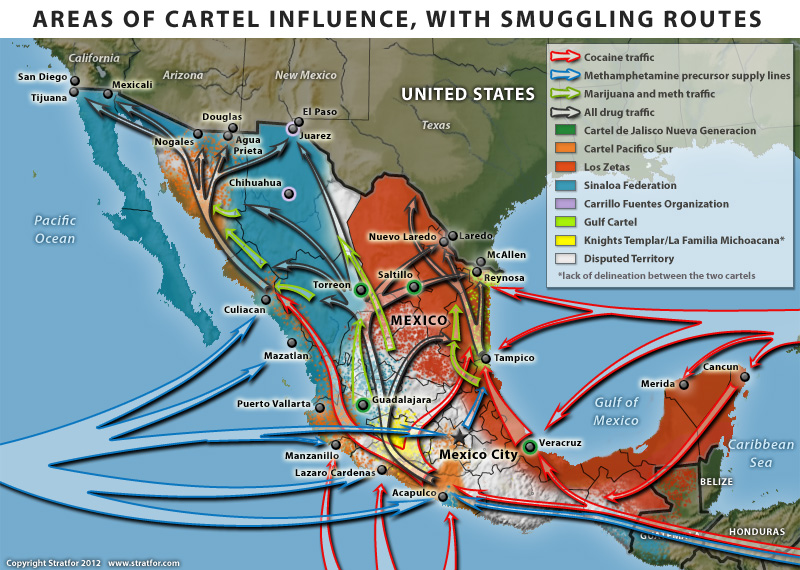
A critical issue in an analysis of the Zapatistas is their link, or lack thereof, to the Mexican drug cartels. Around 2010, Chiapas, where the Zapatistas generally operate, was considered under the control of the Sinaloa Federation. Nowadays, territories within that state has been classified by intelligence analysts at STRATFOR as either under the control of the Zetas cartel or as “disputed territory.” The aforementioned STRATFOR map should be taken with a grain of salt, particularly when it comes to fully understanding how vast the Zeta’s influence is. Nevertheless, it does provide general idea of their current area of operations, given the vast array of criminal enterprises which they are involved in, from drug trafficking to human trafficking. The possibility of Zetas influence in southern Mexico is not surprising. It is clear that the cartel has been expanding to the southern areas of the country and has even established a presence across the border in neighboring Guatemala. As previously mentioned, it makes sense for the Zetas to be involved in the southern border areas of the country as this cartel has become heavily involved in human trafficking originating in Central America all the way to the Mexican-U.S. border.
To what extent, if any, do the Zapatistas have relations with drug cartels like the Zetas? According to a plethora of declarations and interviews with Marcos, the EZLN’s raison d’être since its foundation was to fight for the poor, oppressed indigenous communities of South Mexico.  Assuming that this is true, it would make sense that they would oppose the cartels and try to stop the narco-violence that has spread throughout so much of the country. A 2012 report by Al Jazeera helps put the situation in perspective. According to the news agency’s virtual map from 2007-2010, there were 304 violent deaths in Chiapas. In comparison, the state of Guerrero, experienced 2,727 deaths due to narco-violence. It is important to remember that this data should not be regarded as definitive; disappearances are not often reported, new graves are constantly being found and it is  debatable whether a murder should be attributed to a cartel or to some other kind of violence (especially considering the high number of unsolved murders in Mexico). In an interview with the author, an analyst that has done significant work on Mexico explained that “for example, Oaxaca has very high levels of political violence that have nothing to do with the cartels.”[3] Hence the Al Jazeera map merely provides an analytical starting point.
Is the lack of major violence in Chiapas, as compared to Guerrero, due to the presence of the Zapatistas? Or can it be explained for other reasons, such as a lack of confrontation between two cartels vying for territorial expansion? The state of Guerrero is an important drug plaza. Hence, there is some sense for the high levels of violence there. On the other hand, Chiapas is more isolated due to its geography and closed communities, which may make the state, arguably, less appealing for the cartels.  Another theory would be that low levels of violence can simply be due to successful governmental security operations and a presence of Mexico’s military and police forces, though that is debatable.
On May 2011, an estimated 20,000 EZLN members in Chiapas took part in a national protest to demand an end to President Felipe Calderon’s military solution to the cartels. Around that time, Marcos declared that the war between the cartels and the government would end in thousands of deaths and a destroyed, uninhabited nation. He also stated that the sole winner in this war was the American military industry. From what has been made public, the Zapatista leader has not taken a position regarding the ongoing battle between the drug cartels and Mexican military. Although one could assume, as previously argued, that the Zapatistas should be fighting against the expansion of the cartels while not necessarily working with the Mexican security forces. Unfortunately, the lack of available information  prevents us from giving a more complete assessment of the reality in Chiapas.
More recently, according to one analyst, the Zapatistas have largely refrained from illegal activity and, instead, have become more of a grassroots social movement in recent years. An analysis in InsightCrime also argues that by turning away from armed struggle, the group has also been afforded a certain amount of political legitimacy. Unlike their guerrilla cousins in Colombia and Peru, the Zapatistas have widespread support both from the Mexican left and on the global stage, where they are known as a spearhead of the anti-globalization movement.
Can it be truly said that the Zapatistas, from the lowest-ranking members to Subcomandante Marcos himself are not involved in drug trafficking? The aforementioned Mexico specialist interviewed by the author argues that Zapatista communities are better able to withstand the spread of the cartels precisely because they are communities that are under less economic strain than other parts of the country. The analyst suspects the cartels steer clear of that region because they have no reason to penetrate those communities and the challenges of doing so are higher.; Leaving aside this speculation, the truth is that greater in-depth research and analysis from the field is needed to better understand the relationship between this movement and the drug cartels.
As both a disclaimer and an acknowledgement of the possible scarcity of information, in preparation for this analysis, this author was unable to find media reports regarding confrontations between EZLN and cartels. This does not necessarily mean that such incidents have not occurred, but rather that they may have gone unreported. Given the territorial overlap between the EZLN and a cartel like the Zetas, which is known for its vicious attacks (such as the Monterrey massacre in which 43 individuals were killed) it is difficult to find credibility in the idea that confrontations between both groups have not occurred at some point.
Analyzing an Unclear Movement
The aforementioned InsightCrime report brings up a critical aspect of how the Zapatistas are regarded by certain analysts. The analysis indirectly compares the EZLN to narco-insurgent movements such as the Colombian FARC, ELN, and Peru’s Shining Path, stating that the EZLN is an entity that is “incongruous” with the rest. Arguably, the Zapatistas do not belong in the same category as groups as the FARC. A major reason for this is the nature of these movements’ stated objectives. While the FARC or Shining Path had as an ultimate goal of carrying out a regime change and installing themselves as the new governments in Colombia and Peru respectively, the Zapatistas’ goal was to promote the rights and protection of the indigenous communities that they represented. In addition, while the EZLN has some Communist traits in its ideology, Shining Path is regarded as having a Maoist tendency.[4] Such ideological differences may not matter so much in the Post-Cold War era, but they are important and should be highlighted in order to properly analyze a violent movement.
There is not enough information available to make a proper assessment of the relationship between the EZLN and Mexican cartels, particularly the Zetas, which have influence in territories close to where the EZLN operates. If all EZLN members are truly committed to the Zapatistas’ goals,  the group would be a cohesive unit that  fights to keep the influence and violence of the cartels out of their regions. Realistically, however, this is wishful thinking at best. Individuals are susceptible to corruption and the ongoing cartel vs. government war in Mexico has provided plenty of examples of corruption cases at all levels of the Mexican government and civil society. Without more transparency from the Zapatistas, it is difficult to assess whether its members, particularly its leaders, have been immune to the cartels, whether via bribes or coercion.
Finally, given the Zapatistas’ objectives, modus operandi and tactics, is it correct to label such a group as a violent extremist movement like the Colombian FARC or Peru’s Shining Path?  Terms such as terrorists, guerrillas, and insurgents tend to be used interchangeably when it comes to labeling organized violent criminal movements. With such general, uniform terminology, it is easy to miss what differences do exist between them.[5] Without going into a discussion of what a terrorist is, we can tentatively utilize a U.S. definition, which defines a terrorist as an entity that resorts to “premeditated, politically motivated violence perpetrated against noncombatant targets by sub-national groups or clandestine agents.” Unlike the Shining Path, for example, the EZLN did not systematically kill innocent civilians via massacres, nor did they resort to tactics such as car bombs to accomplish objectives in the war against the government. For example, the Shining Path’s first known operation was the mass murder of 69 civilians in 1983 – an action which defined them to the Peruvian public. A critical reason why the Zapatistas became popular both within Mexico and abroad was precisely because they did not resort to such wanton brutality. Nevertheless, whether justified or not, the EZLN is a movement that has risen against the Mexican government and has, at times, resorted to violence.[6]
Conclusions
The EZLN remains a fascinating case of a violent movement that appeared in the post-Cold War era Latin America, with some leftist aspects to its ideology and with goals that do not include regime change. Furthermore, from what is known, they have neither engaged in an all-out war against Mexican security forces nor have they carried out attacks against civilian non-combatants The fact that some Zapatista communities have been harassed for paramilitary groups calls into question their level of organization and whether they posses any weapons with which to defend themselves. Nevertheless, positive characterizations of a “peaceful” Zapatista movement as the one issued by the aforementionedInsightCrime analysis demand greater research regarding the reasons why this movement has not been violent in recent years.. In spite of any changes or drawdowns, more research and transparency is necessary to understand the group’s current status, and its ties, or lack thereof, with the country’s drug cartels, particularly the Zetas.
A critical issue worthy of further debate and analysis is whether the Zapatistas should be regarded as some kind of blueprint for future violent movements in Latin America. Will violent groups appear that may have some general political ideology, most likely with leftist tendencies, but with specific demands around a specific population but does not include regime change? In other words, will we see the rise of localist violent movements in the future as compared to grandiose ones that strive for regime change? The Zapatistas are arguably the first group that has emerged with such a pattern, and it is debatable whether the same types of conditions that fomented their apparition and durability can be duplicated in other regional states. Nevertheless, Latin America is known for being a region home to historical grievances, and, unfortunately, home to a cycle of violence that tends to perpetuate itself.
—
W. Alex Sanchez is a Research Fellow at the Council on Hemispheric Affairs (COHA) where he focuses on geopolitics, military and cyber security issues. He regularly appears in different media outlets like Al Jazeera, VOXXI, BBC, El Comercio (Peru), New Internationalist, among others. His analyses have appeared in numerous refereed journals including Small Wars and Insurgencies, Defence Studies, the Journal of Slavic Military Studies, European Security, Studies in Conflict and Terrorism and Cuban Affairs. Alex can be followed on Twitter here.


[1] For a good summary of the EZLN’s history, see: Arsenault, Chris. “Zapatistas: The War with no Breath?” Al Jazeera. Features. January 1, 2011. Available: http://www.aljazeera.com/indepth/features/2011/01/20111183946608868.html
[2] For a good analysis of the 1994 uprising when it occurred, see: Wager, Stephen J. and Schulz, Donald E. “The Awakening: The Zapatista Revolt and Its Implication for the Civil-Military Relations in Mexico.” Strategic Studies Institute.United States Army War College. December 30, 1994. Available: http://1.usa.gov/RZle9Z
[3] Email interview with the author. September 27, 2012.
[4] For a good analysis of Shining Path’s political ideology, see: Starn, Orin. “Maoism in the Andes: The Communist Party of Peru-Shining Path and the Refusal of History.” J. of Latin American Studies. 27. P. 399-421. Available: http://www.latinamericanstudies.org/peru/shining-path.pdf
[5] Some academic articles that discuss the definition of terrorism and other terms include: Bosco, David. Bulletin of the Atomic Scientists.Jan/Feb2006, Vol. 62 Issue 1, p44-51. Also see: Schmid, Alex. Case Western Reserve Journal of International Law. Spring2004, Vol. 36 Issue 2/3, p103-147. Also see: Grob-Fitzgibbon, Benjamin. Peace & Change. Apr2005, Vol. 30 Issue 2, p231-246. Also see: Saul, Ben. Chinese Journal of International Law.2005, Vol. 4 Issue 1, p141-166.
[6] For a good analysis regarding Zapatismo ideology vs. Mexican politics see: Stephen, Lynn. “Pro-Zapatista and Pro-Pri: Resolving the Contradictions of Zapatismo in Rural Oaxaca.” Latin American Research Review. 32.2. 1997.